Structural DesignCreoChassis DesignTubular Frame DesignNX NastranStructural Analysis
Go-Kart Chassis Design
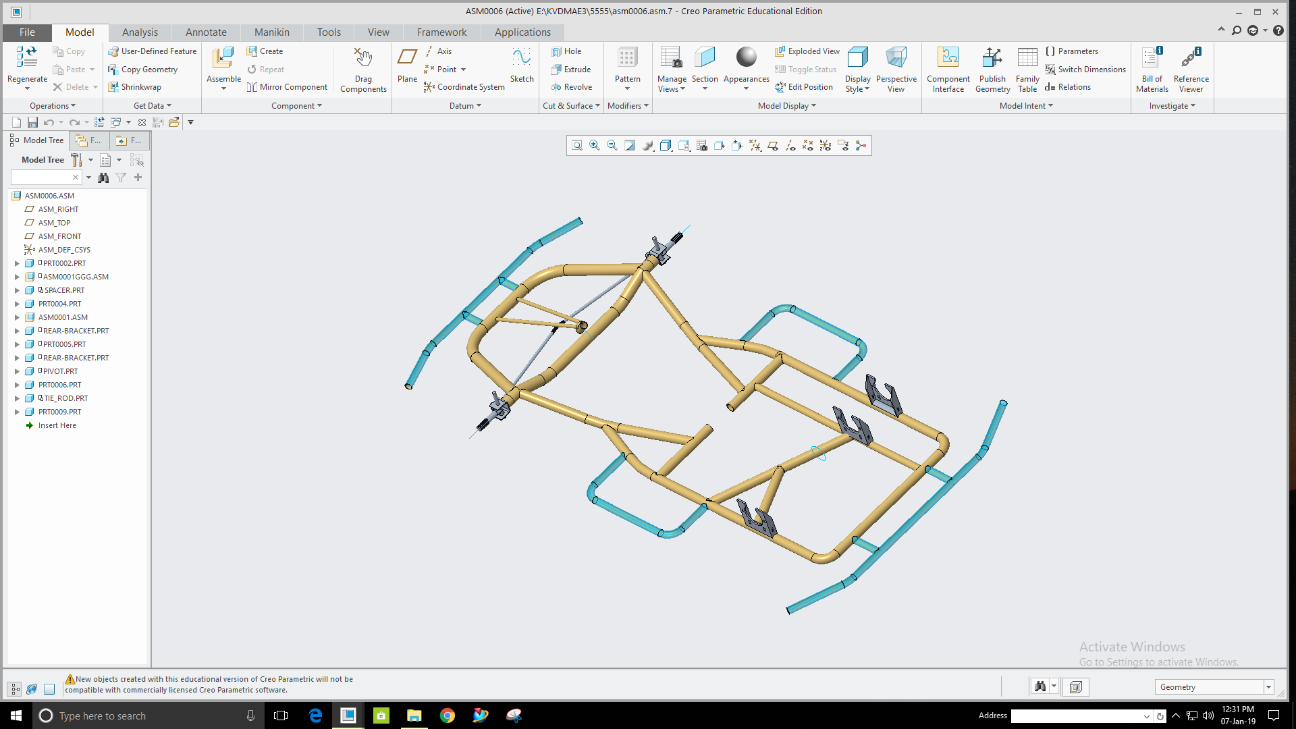
Design a lightweight yet structurally robust chassis capable of supporting the engine, driver, seat, and other vehicle components while meeting safety and performance requirements for a competition go-kart.
A racing chassis has to resolve two goals that usually pull in opposite directions — minimum weight for acceleration and top speed, and enough torsional and bending stiffness to keep the driver safe and the handling predictable under racing loads.
I led the chassis design effort for the team, starting from packaging constraints (engine, seat, driver envelope, steering geometry) and developing the frame using tubular space-frame principles in Creo. I iterated the tube routing and node layout to keep load paths short and direct, then modeled the complete assembly for manufacturability by our welding team.
Full parametric tubular-frame assembly built in Creo, including mounting brackets for the engine, seat, and steering column, with tube diameters and wall thickness selected for the expected loading.
The finalized chassis geometry was evaluated using NX Nastran to verify strength and load-carrying capability under representative racing loads (braking, cornering, and impact cases).
Estimated static and dynamic loads at the seat mounts, engine cradle, and suspension pickup points; cross-checked tube gauge selections against expected bending and torsional loads before committing to the FEA model.
Chose a triangulated tubular space-frame over a monocoque for faster fabrication and easier repair, and located the engine cradle low and central to keep the center of gravity favorable for handling.
Frame designed for welded tubular-steel fabrication, with node geometry simplified so every joint could be cut and welded with standard workshop tooling.
Structural steel tubing, selected primarily for weldability, availability, and a predictable strength-to-weight ratio for a first-generation competition frame.
NX Nastran results confirmed the frame carried the target loads without exceeding safe stress margins, giving the team confidence to proceed to fabrication.
Balancing minimum weight against the torsional and bending stiffness needed for safe, predictable handling — resolved by iterating tube routing around a triangulated space-frame before committing to FEA.
Completed a manufacturable chassis design that met the competition's technical and safety specifications.
Verified structural adequacy of the frame using NX Nastran prior to fabrication.
Coordinated technical documentation and manufacturing planning across the team.
This project sharpened how I think about the trade-off between weight and stiffness in a structure, and reinforced the value of validating a design analytically before committing to fabrication.