Structural AnalysisCreoANSYSFEAStress AnalysisCAD Modeling
Rivet Joint — Structural FEA
Understand the structural behavior of riveted joints, commonly used to join sheet-metal components in aircraft structures.
Riveted joints concentrate stress around the fastener holes, and predicting where that concentration will be highest is essential to avoiding fatigue failure in service.
I created the riveted joint assembly in Creo and performed a finite element analysis in ANSYS to evaluate stress and deformation of the joint under applied loading.
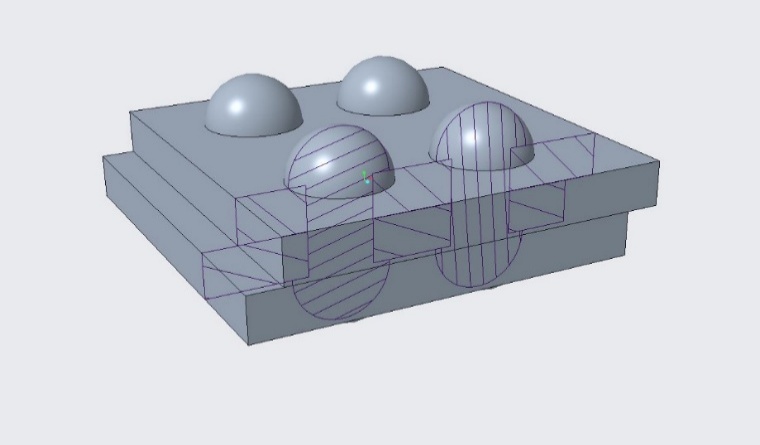
CAD assembly of the riveted joint built in Creo, representing the sheet-metal plates and rivet fasteners at the joint interface.
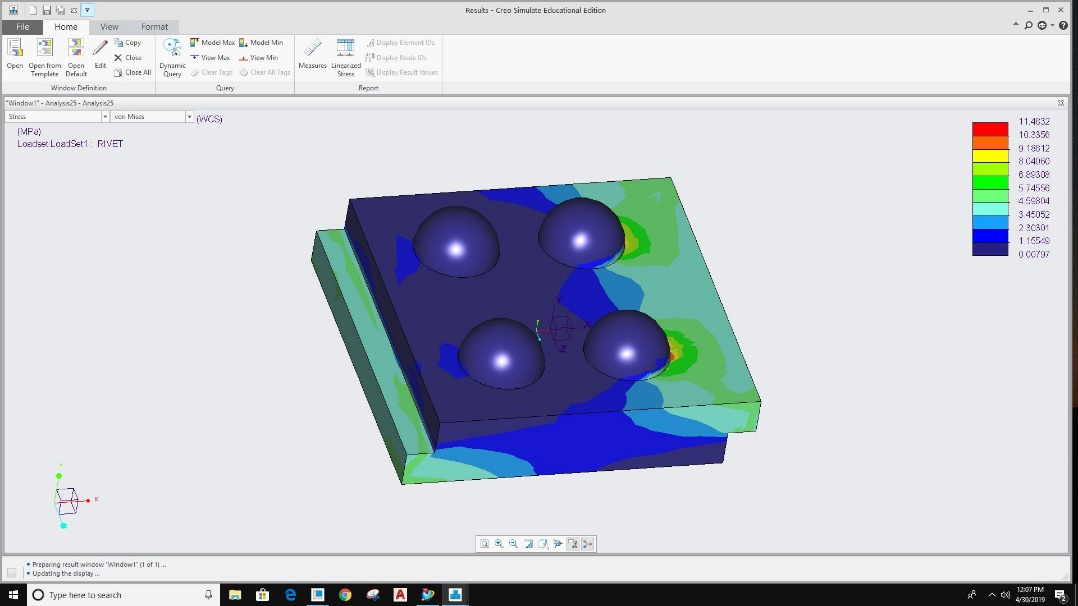
FEA in ANSYS to evaluate stress distribution and deformation of the joint under representative tensile loading.
Estimated load transfer through the fasteners to set up realistic boundary conditions and contact behavior in the FE model.
Focused mesh refinement around the rivet holes, where stress concentration was expected to govern the joint's structural performance.
Modeled as a riveted sheet-metal assembly, consistent with standard aircraft structural joining practice.
Aircraft-grade sheet-metal plates joined with metallic rivets, evaluated using standard structural properties.
The analysis showed how load is transferred through the rivets and highlighted the regions of higher stress concentration around the fasteners.
Capturing stress concentration accurately around small fastener holes without making the overall model too heavy to solve — resolved with local mesh refinement at the rivets.
Quantified stress and deformation of the riveted joint under applied load.
Identified the fastener locations with the highest stress concentration.
Built a clearer picture of how load transfers through a multi-rivet joint.
This project deepened my understanding of fastener-level stress concentration — knowledge that carries directly into aircraft sheet-metal structural design and fatigue-aware detailing.